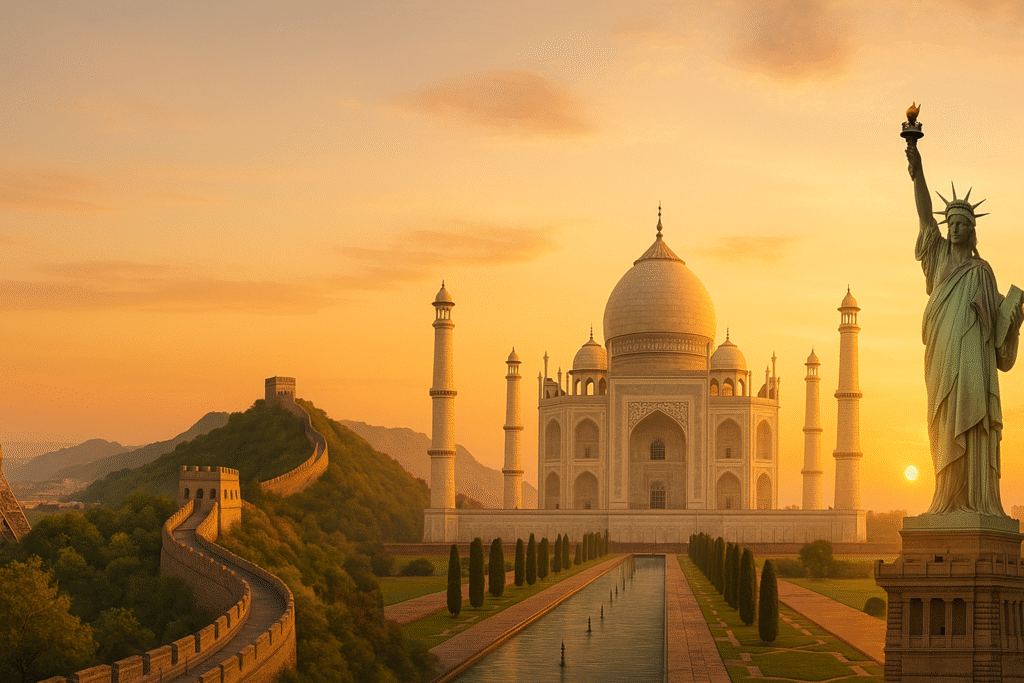
Monuments don’t just decorate landscapes — they define history, identity, and imagination. Among the countless landmarks around the globe, some rise higher in significance because of the stories they carry. Today, we take a journey across four legendary creations that reflect love, freedom, culture, and human ambition.
Let’s travel across Paris, Beijing, Agra, and New York City — one story at a time.
1. The Eiffel Tower – Paris, France
A symbol of elegance and innovation, the Eiffel Tower stands tall in the heart of Paris. Built in 1889 for the World’s Fair, the tower was initially criticized for its design. Yet, over time, it transformed into one of the most loved and photographed landmarks in the world.
Why It Matters
- Represents French art, culture, and engineering brilliance
- A global symbol of romantic city life
- An architectural masterpiece standing 1,083 feet tall
From sparkling night illuminations to panoramic views over Paris, the Eiffel Tower is an experience that blends dream and reality.
2. The Great Wall of China – China
Stretching over 13,000 miles, the Great Wall of China remains one of the most astonishing feats of human strength and persistence. Built across centuries by multiple dynasties, it was originally constructed to protect kingdoms from invasions.
Why It Matters
- A symbol of endurance, resilience, and national heritage
- Recognized as one of the New Seven Wonders of the World
- It winds through mountains, deserts, and rural landscapes
Walking the Wall is like stepping into a living timeline of China’s ancient civilization — and I actually captured this feeling in a short reel. Check it out on my page.
3. The Taj Mahal – Agra, India
Often described as a poem written in marble, the Taj Mahal is the world’s greatest symbol of love and devotion. Built by Emperor Shah Jahan in memory of his wife Mumtaz Mahal, it stands gracefully on the banks of the Yamuna River.
Why It Matters
- A UNESCO World Heritage Site and global symbol of love
- Famous for its white marble that changes shades across the day
- A perfect blend of Persian, Indian, and Mughal architecture
The Taj Mahal is not just seen — it is felt.
4. The Statue of Liberty – New York City, USA
Gifted by France to the United States in 1886, the Statue of Liberty represents freedom, hope, and new beginnings. Standing at 305 feet on Liberty Island, it was the first sight many immigrants saw as they arrived in America in search of a new life.
Why It Matters
- Symbolizes democracy and liberty
- A welcoming icon for millions arriving through Ellis Island
- One of the most recognized figures in world history
To this day, Lady Liberty remains a powerful reminder that freedom is a light that must always be protected.
The World Through These Landmarks
Each of these landmarks carries a message:
| Landmark | Represents | Key Message |
|---|---|---|
| Eiffel Tower | Art & Innovation | Human creativity can redefine beauty |
| Great Wall of China | Strength & Endurance | Persistence shapes legacy |
| Taj Mahal | Eternal Love | Love can become immortal |
| Statue of Liberty | Freedom & Opportunity | Hope lights new beginnings |
Together, they show what humanity is capable of when it builds not just for necessity — but for meaning, emotion, and identity.
Conclusion
The Eiffel Tower, Great Wall of China, Taj Mahal, and Statue of Liberty are more than tourist attractions — they are chapters of human history standing in stone, steel, and marble.
Follow me on Instagram and Facebook for more travel stories, culture insights, and historic explorations.
Instagram
Facebook
They remind us of:
- our stories
- our struggles
- our dreams
And most importantly — they remind us of who we are.